nivasnanicreations@gmail.com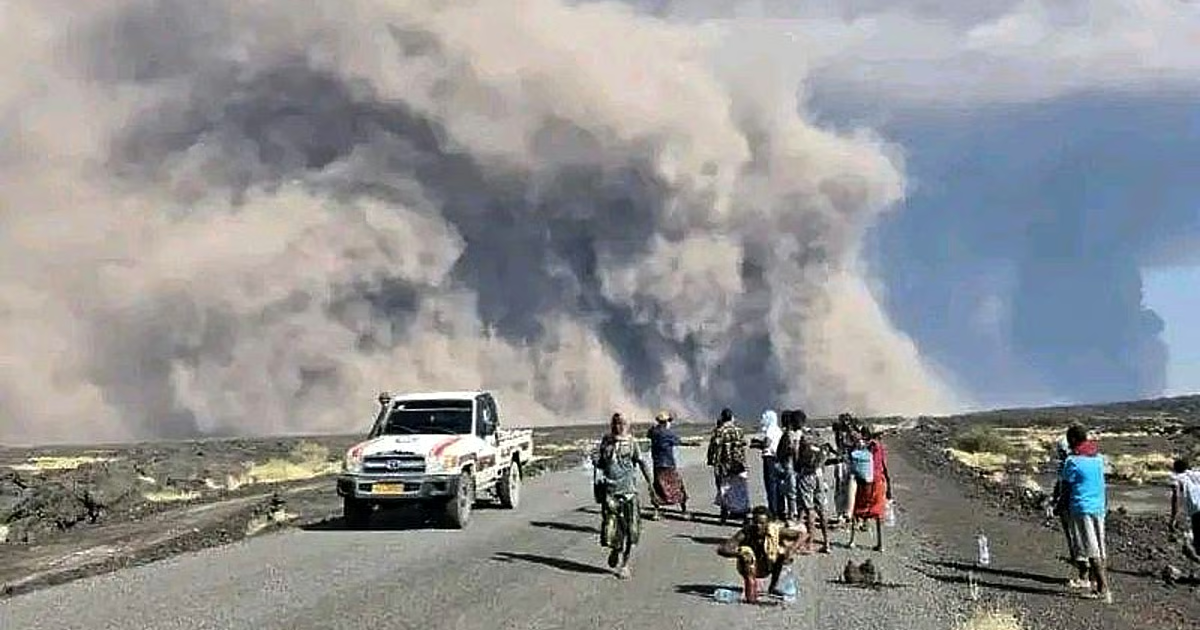
Introduction
The usually serene horizons of the Indian subcontinent were momentarily overcast by an extraordinary international event. The explosive eruption of the Hayli Gubbi volcano in Ethiopia. After lying dormant for an astonishing 12,000 years—since the end of the last Ice Age. The shield volcano in Ethiopia’s Afar region. Approximately 800 km northeast of Addis Ababa near the Eritrean border, roared back to life on Sunday, November 23, 2025. The eruption produced a colossal ash plume that soared up to 14 kilometers (45,000 feet) into the atmosphere. Triggering a swift and widespread safety response in India as the ash cloud began its eastward drift across the Arabian Sea.
This geological event, rare in its magnitude and the dormancy period of the volcano, instantly became a global aviation and environmental concern. Carried by high-level winds, the dense plume of abrasive, glass-like volcanic ash travelled across the Red Sea. Over Yemen and Oman, and subsequently headed for the western and northern parts of India. For Indian aviation authorities and airlines, this posed an immediate, existential threat to flight safety.
The Immediate Crisis in Indian Airspace
The primary concern was the catastrophic damage volcanic ash can inflict on jet engines. The fine, glass-like particles are highly abrasive, capable of stripping components, and, critically. They melt at the high temperatures inside a combustion chamber. Once melted, they harden into a glass-like coating that can choke the turbine blades, leading to sudden and complete engine failure.
The Directorate General of Civil Aviation (DGCA) in India reacted promptly. Issuing advisories urging all domestic and international airlines to strictly steer clear of affected altitudes and regions. This proactive measure was vital, especially as forecast models indicated a significant influence of the ash cloud over Gujarat, Delhi-NCR, Rajasthan, Punjab, and Haryana on Tuesday.
The impact on air travel was immediate and tangible. Air India, the nation’s flag carrier, bore the brunt of the initial disruption. By Tuesday morning, the airline had cancelled at least 11 flights since Monday. These included key international services such as AI 106 (Newark-Delhi), AI 102 (New York (JFK)-Delhi), and AI 2204 (Dubai-Hyderabad), alongside domestic routes. Beyond cancellations, Air India initiated precautionary checks on all aircraft that had flown over areas suspected to have ash plumes, prioritizing the safety of its fleet, passengers, and crew. Ground teams were mobilized to assist stranded passengers with re-accommodation and alternative travel arrangements.
Other major airlines followed suit with similar cautionary measures. IndiGo and Akasa Air issued statements assuring passengers of their top priority being safety, confirming they were in close coordination with international aviation bodies. The impact was felt keenly at major transit hubs. Cochin International Airport Limited (CIAL) reported the cancellation of two international flights—Indigo service 6E1475 (Cochin–Dubai) and Akasa Air flight QP550 (Cochin–Jeddah)—as a precautionary measure. Similarly, Chhatrapati Shivaji Maharaj International Airport in Mumbai issued an advisory, noting the effect on airspace over parts of West Asia and urging passengers to check their flight status before departure.
An Environmental Double-Edged Sword for North India
In addition to aviation risks, the ash cloud presented a frightening prospect for environmental health. Particularly in the already-suffocating atmosphere of North India. The national capital, Delhi, has been perpetually plagued by ‘very poor’ air quality, with the Air Quality Index (AQI) hovering in the dangerous range (e.g., 360-382). The concern was that the incoming volcanic ash, a dense mix of particulate matter. Could merge with and exacerbate the existing layer of toxic haze, deepening the ongoing air pollution crisis and presenting a serious public health risk across the affected states.
Relief and Resolution: The IMD’s Forecast
Fortunately, meteorological monitoring provided a measure of relief and a clear timeline for recovery. The India Meteorological Department (IMD) played a crucial role, utilizing satellite imagery, Volcanic Ash. Advisory Centre (VAAC) advisories, and dispersion models to track the plume’s trajectory precisely.
IMD Director General Mrutyunjay Mohapatra confirmed that the ash cloud. Having drifted across the Arabian Sea, was primarily on a path towards China. Crucially. The forecast predicted that the high-altitude ash cloud would move away from Indian skies entirely by 7:30 p.m. on Tuesday, November 25. This prediction allowed authorities and airlines to manage the crisis with a defined end point. Minimizing panic and enabling strategic planning for the resumption of normal operations.
In summary, the Hayli Gubbi eruption served as a powerful, albeit short-lived. Reminder of the global interconnectedness of natural systems and the swift. Decisive action required from national bodies to safeguard public infrastructure and life against international phenomena. The coordinated response of the DGCA, IMD, and Indian airlines ensured. That a potential disaster was managed effectively, prioritizing passenger and aircraft safety above all else.