nivasnanicreations@gmail.com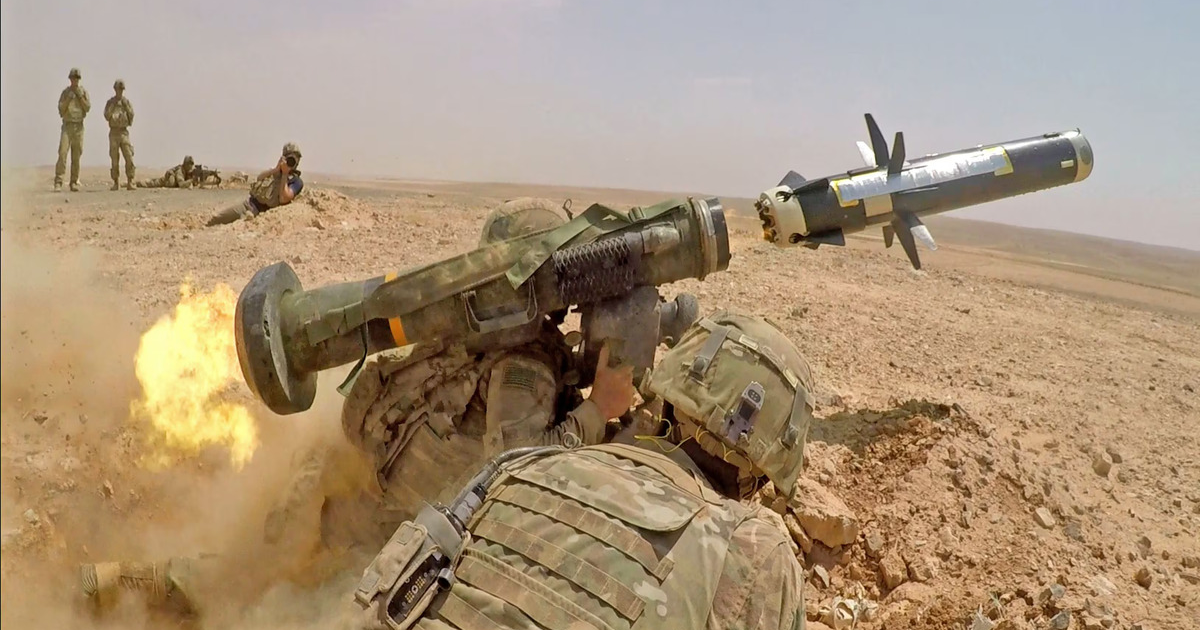
Introduction
In a major development marking the strengthening of defence cooperation between India and the United States, US Approves $93 Million Arms Sale to India, featuring advanced missile systems and key military technologies. The decision, announced through the U.S. Defense Security Cooperation Agency (DSCA), underscores Washington’s commitment to supporting India’s defence modernization and regional security objectives, especially in light of ongoing geopolitical tensions in the Indo-Pacific.
This arms package is expected to introduce enhanced operational capabilities to the Indian Armed Forces, particularly in the areas of homeland security, combat readiness, and deterrence strategy. At a time when global defence realignments are shifting rapidly, this move positions India as a vital strategic partner for the United States.
The official announcement can be referenced on the U.S. Department of State website here:
🔗 https://www.state.gov/
What Weapons and Systems Are Included in the $93 Million Deal?
While the complete list of hardware has not been publicly disclosed, the DSCA has confirmed the inclusion of:
1. Advanced Missile Systems
The deal involves the purchase of precision-guided missiles, which are critical for both defensive and offensive operations. These high-accuracy systems allow India to enhance its quick-response capabilities during conflicts.
2. High-End Projectiles
India will receive state-of-the-art projectiles designed for long-range engagements. These will support artillery and infantry operations, giving Indian forces an advantage in mountainous and border terrains.
3. Support & Maintenance Systems
The package also includes:
- Technical assistance
- Weapon integration support
- Training modules for Indian military personnel
- Repair and maintenance infrastructure
This ensures that India not only receives the weapons but also the operational ecosystem needed for long-term sustainability.
More details can be reviewed under DSCA notifications at:
🔗 https://www.dsca.mil
Why This Deal Matters for India
India has been aggressively modernizing its armed forces, given its vast land borders, oceanic coverage, and rising regional challenges. The new arms deal addresses several strategic priorities.
1. Strengthening Homeland Security
The missile systems will significantly boost India’s internal and border security framework. The Indian Army and Air Force will be better equipped to respond to:
- Drone attacks
- Cross-border infiltration
- High-altitude standoffs
- Precision strikes by adversaries
2. Deterrence Against Regional Threats
India faces unpredictable border dynamics, especially along:
- The Line of Actual Control (LAC) with China
- The Line of Control (LoC) with Pakistan
High-precision weaponry acts as a deterrent, signaling that India is prepared to respond decisively to any provocation.
3. Encouraging Self-Reliance Through Technology Transfer
The U.S. is increasingly collaborating with India in the defence manufacturing sector. While this deal may not directly include technology transfer, it strengthens the environment for:
- Joint development
- Co-production
- Defence innovation
within India’s domestic industry.
India’s defence initiatives can be tracked on the Ministry of Defence portal:
🔗 https://www.mod.gov.in
US–India Defence Partnership: A Growing Strategic Bond
This arms sale is not an isolated development. It is part of a much broader strategic shift over the past decade.
Major Milestones in Defence Cooperation:
1. Major Defense Partner (MDP) Status
In 2016, the U.S. designated India as a “Major Defense Partner,” granting access to sensitive military technologies.
2. Foundational Pacts Signed Between the Two Countries
India and the U.S. have signed all major defence agreements:
- LEMOA (Logistics Exchange Memorandum of Agreement)
- COMCASA (Communications Compatibility and Security Agreement)
- BECA (Basic Exchange and Cooperation Agreement)
These pacts facilitate seamless cooperation in logistics, communications, and intelligence sharing.
3. Joint Military Exercises
India and the U.S. conduct multiple high-level exercises, such as:
- Yudh Abhyas
- Tiger Triumph
- Vajra Prahar
- Malabar Naval Exercise
These drills ensure interoperability of forces and tech alignment.
More details on Indo-US defence relations can be found here:
🔗 https://in.usembassy.gov/
Impact on the Indo-Pacific Region
The Indo-Pacific has become a hotspot for geopolitical competition. With China expanding its naval footprint and building military infrastructure in the South China Sea, countries like the U.S., India, Japan, and Australia are reinforcing their positions.
How this deal influences regional dynamics:
1. Strengthens QUAD’s Strategic Framework
India, as a key member of the QUAD (Quadrilateral Security Dialogue), plays a vital role in counterbalancing Chinese influence. Advanced defence equipment enhances India’s ability to contribute to regional stability.
2. Reinforces Maritime Security
India’s capabilities in the Indian Ocean Region (IOR) will improve, helping it to:
- Track maritime threats
- Counter submarine activities
- Secure trade routes
3. Sends a Message to Regional Adversaries
The collaboration serves as a strong diplomatic signal that India and the U.S. are aligned on security goals.
Domestic Reaction and Policy Perspectives
Indian defence experts, retired military officers, and strategic analysts have widely welcomed the deal.
Positive Expectations:
- Improved strike accuracy
- Enhanced border defence
- Stronger Indo-US diplomatic ties
- Boost to India’s global strategic relevance
Concerns Raised:
Some experts argue that too much dependence on foreign military imports may hurt India’s Atmanirbhar Bharat (self-reliant India) defence vision. Others emphasize the importance of negotiating technology transfer and co-production in future deals.
Conclusion
The U.S. approval of a $93 million arms sale to India marks an important development in global defence cooperation. It enhances India’s military capabilities, strengthens its deterrence posture, and reinforces the Indo-US strategic partnership at a time of evolving regional challenges.
With new missile systems, advanced projectiles, and improved operational support, India is well-positioned to continue its defence modernization journey—and to play an increasingly influential role in maintaining peace and stability in the Indo-Pacific region.